
Top AC DC Power Adapter Suppliers for Global Buyers
Choosing reliable power supply partners requires more than comparing prices and product photos. An Ac Dc Power Adapter must deliver stable output, safe insulation, efficient conversion, and consistent performance across operating conditions. Global buyers also need to examine input voltage ranges, plug types, connector dimensions, cable quality, and protection features. Details matter.
This guide introduces leading Ac Dc Power Adapter suppliers serving international markets. It considers manufacturing experience, engineering capability, quality systems, customization support, and export reliability. Strong suppliers should provide clear datasheets, sample testing, traceability records, and realistic production timelines. Buyers should also review relevant safety and electromagnetic compatibility requirements, such as IEC 62368-1 and applicable regional standards. Certification claims deserve verification through recognized testing laboratories.
A supplier may appear impressive during a sales call but perform differently during mass production. That assumption fails. Practical evaluation should include load testing, temperature checks, plug retention tests, and inspection of packaging before shipment. Payment terms, minimum order quantities, warranty procedures, and after-sales response also influence long-term value. Supply chains change.
No supplier ranking stays perfect forever. Factory ownership, component sourcing, and compliance status can shift without obvious warning. For that reason, this overview should support due diligence rather than replace it. The most dependable choice is usually the supplier that communicates limitations clearly, documents each specification, and responds responsibly when problems arise. Real purchasing decisions need evidence, not polished promises.
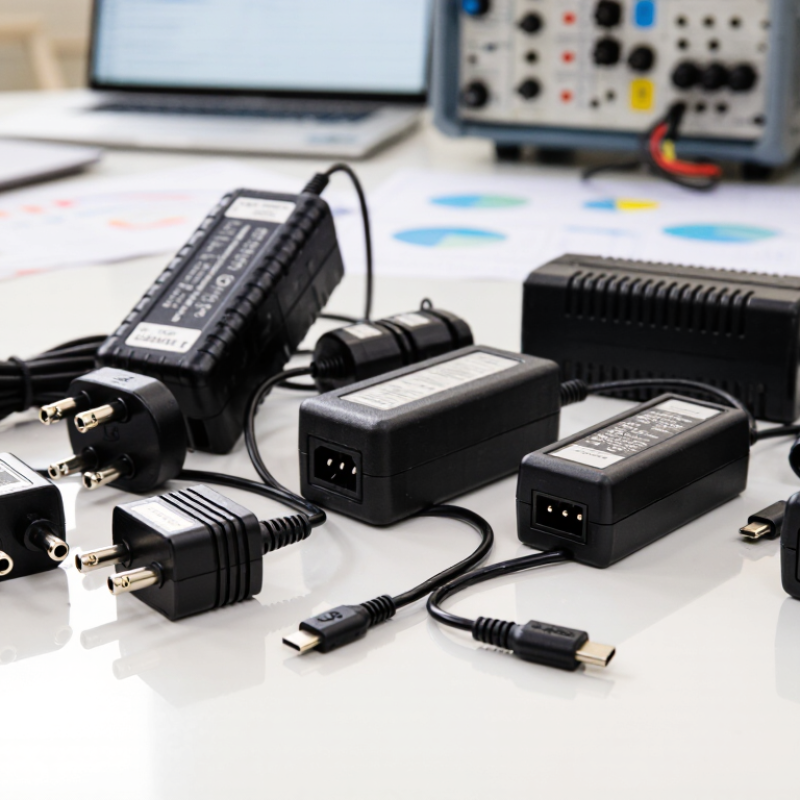
Understanding AC DC Power Adapters and Their Applications
AC DC power adapters convert wall current into stable, usable DC power. Their internal stages include rectification, switching, isolation, and feedback control. A 100–240 V input supports international deployment. Output voltage, current, polarity, connector size, and ripple must match the equipment exactly. Typical applications include laptops, networking devices, industrial sensors, lighting controls, and medical instruments. Medical equipment needs stricter insulation and leakage-current controls under IEC 60601-1. Small details matter.
Efficiency is now a purchasing requirement, not a marketing extra. The U.S. Department of Energy’s Level VI framework evaluates active-mode efficiency and no-load consumption. European Commission Regulation (EU) 2019/1782 sets no-load limits as low as 0.10 W for many external power supplies. These rules reduce wasted energy when devices remain plugged in. However, higher wattage does not automatically mean better performance. Engineers sometimes over-specify capacity, creating unnecessary cost and bulk. I have seen adapters fail because the connector fit, not the rated power, was overlooked.
Tips: Confirm the device’s voltage first, then check current capacity. Choose an adapter with documented safety testing and thermal protection. For factories, review operating temperature, surge tolerance, and cable strain relief. For global buyers, request test reports, efficiency data, and regional plug options before sampling. A perfect specification is rare. Recheck real operating conditions.
Key Criteria for Evaluating Global Power Adapter Suppliers
Top AC DC Power Adapter Suppliers for Global Buyers
Key Criteria for Evaluating Global Power Adapter Suppliers
A reliable supplier should provide clear specifications for input range, output stability, efficiency, and protection features. Ask for test reports covering overvoltage, short-circuit, overheating, and insulation performance. A polished website proves little. Physical samples reveal more.
Experienced buyers should inspect factory controls, not only product samples. Check component traceability, calibration records, production capacity, and final inspection procedures. Suppliers with documented quality systems usually manage repeat orders more consistently. Still, records can become outdated, so request recent evidence.
Compliance support also matters for international shipments. The supplier should explain applicable safety and electromagnetic compatibility requirements for each target market. Confirm labeling, plug configurations, packaging strength, and technical files before placing a large order. Small details matter.
Communication is another practical test. Ask how quickly engineers answer technical questions and handle design changes. Reliable teams discuss limitations instead of promising everything. Lead times should include testing, production, and shipping buffers. A low quotation may hide weak support, inconsistent components, or expensive rework. Payment terms, warranty coverage, replacement procedures, and failure analysis should be written clearly. Even strong suppliers make mistakes; their response after a failure often shows more than their sales presentation. Request a pilot order before committing to continuous volume.
Top AC DC Power Adapter Suppliers for Global Buyers — Key Criteria for Evaluating Global Power Adapter Suppliers
This illustrative buyer scorecard uses a 100-point weighting model. Safety compliance, electrical performance, global input compatibility, reliability, documentation, and logistics are commonly assessed when comparing international AC/DC power adapter suppliers.
Leading AC DC Power Adapter Suppliers by Market Strength
Top AC DC Power Adapter Suppliers for Global Buyers
Leading AC DC Power Adapter Suppliers by Market Strength
Market strength is not measured by factory size alone. Strong suppliers consistently manage quality, delivery, documentation, and technical support across regions. Global buyers should review production capacity, incoming inspection, and failure data before approving an adapter supplier.
Large-scale manufacturers often support high-volume orders and multiple input standards. They usually provide stable tooling, automated testing, and established logistics networks. Ask for evidence, not polished claims. Useful records include thermal test results, output ripple measurements, aging reports, and corrective-action histories. Compliance documents should match the exact model, plug type, and target market.
Regional specialists can offer faster communication and more flexible engineering. They may adjust cable length, connector design, or enclosure details for a smaller project. However, their backup capacity can be limited during seasonal demand. That weakness matters. A delayed shipment can interrupt an entire device launch.
OEM-focused suppliers often perform well when a product needs a custom voltage, compact housing, or special labeling. Their engineering teams should explain protection features clearly, including overvoltage, short-circuit, and overtemperature protection. Sample testing remains essential. One approved sample does not prove long-term consistency.
I have seen procurement teams choose the lowest quotation and later face unstable output under heat. That decision looked efficient, but it was incomplete. A practical supplier review should combine factory audits, pilot orders, independent testing, and clear warranty terms. Reliability grows from repeated evidence.
| Supplier Market Profile | Primary Market Coverage | Common Output Range | Typical Input Coverage | Common Compliance Pathways | Key Market Strengths | Best-Fit Buyer Requirements | Market Strength |
|---|---|---|---|---|---|---|---|
| Large-scale East Asian OEM/ODM production base | North America, Europe, Asia-Pacific, Latin America, and the Middle East | 5 W–300 W for consumer, networking, industrial, and embedded applications | 100–240 V AC, 50/60 Hz; regional plug configurations available | IEC/EN/UL 62368-1 where applicable; CE, RoHS, CCC, PSE, KC, and other market-specific requirements | Broad product portfolios, high-volume manufacturing, rapid customization, and extensive plug options | Global distributors, equipment manufacturers, private-label programs, and high-volume projects | Very High |
| European compliance-oriented supplier base | European Union, European Economic Area, Switzerland, and selected export markets | 5 W–250 W for consumer electronics, office equipment, lighting, and industrial controls | 100–240 V AC, 50/60 Hz; EU and international cord sets commonly supported | CE marking, RoHS, REACH-related documentation, and applicable EU ecodesign requirements, including Regulation (EU) 2019/1782 for external power supplies | Strong technical documentation, energy-efficiency focus, traceability, and environmental compliance support | European importers, regulated products, public-sector procurement, and sustainability-focused buyers | High |
| North American safety-focused supplier base | United States, Canada, Mexico, and international OEM programs | 5 W–300 W for IT equipment, telecommunications, medical-related equipment, and industrial electronics | 100–240 V AC, 50/60 Hz; North American plugs and international configurations | UL/CSA certification or recognition where required; IEC/UL/CSA 62368-1 is commonly relevant for AV and ICT equipment | Strong emphasis on product safety, engineering support, system integration, and documentation for regulated buyers | North American brands, system integrators, enterprise hardware, and compliance-sensitive applications | High |
| Japan-market specialist supplier base | Japan, Asia-Pacific, and selected global export channels | 5 W–200 W for consumer devices, communications equipment, test instruments, and industrial products | 100–240 V AC, 50/60 Hz; Japan-compatible input configurations available | PSE requirements under Japan’s Electrical Appliances and Materials Safety Act, plus applicable IEC-based safety testing | Reliable quality control, compact designs, stable engineering processes, and strong attention to component consistency | Japanese distributors, precision equipment makers, and buyers requiring documented product reliability | High |
| South Korean electronics supply base | South Korea, Asia-Pacific, North America, and Europe | 5 W–250 W for displays, networking devices, consumer electronics, and industrial equipment | 100–240 V AC, 50/60 Hz; regional plug systems supported | KC-related requirements for the Korean market, together with IEC/EN safety and EMC testing for exports | Strong electronics ecosystem, efficient product development, compact power designs, and good OEM integration | Electronics manufacturers, connected devices, display equipment, and short product-development cycles | High |
| Taiwanese engineering and ODM supplier base | Global markets, especially networking, computing, industrial, and communications sectors | 5 W–500 W, including higher-power external supplies for networking and industrial equipment | 100–240 V AC, 50/60 Hz; worldwide plug systems commonly available | IEC/EN/UL 62368-1, CE, RoHS, FCC-related system requirements, and BSMI requirements where applicable | Strong ODM capability, advanced power engineering, thermal design, customization, and long-term product support | Networking brands, industrial OEMs, computing equipment makers, and technically demanding buyers | Very High |
| India-focused and cost-competitive regional supplier base | India, South Asia, the Middle East, and selected emerging markets | 5 W–150 W for consumer electronics, telecom accessories, lighting, and general industrial use | 100–240 V AC, 50/60 Hz; local and international plug configurations may be available | BIS and applicable Indian safety requirements for products sold in India, plus IEC-based testing for export programs | Regional fulfillment, competitive pricing, localized support, and shorter supply routes for South Asian buyers | Domestic distributors, regional OEMs, replacement markets, and cost-sensitive procurement programs | Medium to High |
| Specialized low-volume and engineering-design supplier base | Global niche markets, laboratories, automation, instrumentation, and professional equipment | 3 W–1,000 W depending on architecture, enclosure, cooling, and application requirements | Application-specific; universal 100–240 V AC input is common for international products | IEC/EN/UL safety standards, EMC testing, RoHS documentation, and application-specific certifications where required | Flexible engineering, custom voltage and connector options, prototype support, and low-to-medium volume production | Product developers, automation companies, laboratories, medical-equipment designers, and specialized OEMs | Strong in Niche Markets |
International Certifications, Compliance, and Safety Requirements
Selecting AC DC power adapter suppliers for global buyers requires more than comparing output voltage and price. A dependable supplier understands regional safety rules and keeps test evidence current. For many products, IEC 62368-1 helps address electrical and fire hazards. EMC testing also checks unwanted emissions and immunity. However, requirements vary by destination, product category, and power rating.
Ask suppliers for certification records, declarations of conformity, factory details, and test reports from recognized laboratories. Check that the documents match the exact adapter model, input range, plug type, and production site. RoHS and REACH documentation may support restricted-substance compliance in relevant markets. Regional marks, such as CE or UKCA, should never be treated as universal approval. A certificate alone is not proof. During supplier reviews, I have seen outdated reports reused for redesigned enclosures, which creates avoidable risk.
Tips: Confirm 100–240V input performance, insulation distance, leakage current, temperature rise, and protection against short circuits. Request sample testing before a large order. Inspect labels, warning symbols, and traceability codes on the adapter and carton. Keep records of corrective actions. Small details matter. Even experienced teams can overlook a plug variation or a changed component. Recheck everything.
How Global Buyers Can Select the Right Supplier and Adapter Model
Selecting an AC DC power adapter supplier requires more than comparing unit prices. Start with the device’s voltage, current, polarity, connector, and operating temperature. A reliable supplier should provide test reports, traceable components, factory audit records, and clear warranty terms. Ask for samples from the same production line, not only catalog units.
Safety comes first. IEC 62368-1 testing supports evaluation of electrical and fire hazards in audio, video, information, and communication equipment. For efficiency, review no-load power and average active efficiency against current market-access rules. The International Energy Agency reported that global electricity demand rose by about 2.2% in 2023, increasing pressure to reduce avoidable adapter losses. Small differences matter across thousands of units.
Model selection should match the real load, not just the label. A 65-watt adapter may suit a laptop, but its thermal performance can change inside a warm enclosure. Confirm output stability, ripple, cable length, connector retention, and protection against overvoltage and short circuits. The Global E-waste Monitor 2024 estimated 62 million tonnes of e-waste were generated in 2022, so service life and repairable design deserve attention. I would also request aging-test data, although many suppliers provide limited detail. That gap needs questioning. Select a supplier that can repeat the same electrical results across production batches, regions, and seasonal demand.