
China Top HDPE Liner Manufacturers for Global Buyers
China’s HDPE geomembrane sector serves projects ranging from landfill cells and reservoirs to mining facilities and aquaculture ponds. For global buyers, selecting a supplier involves more than comparing quotations. Resin consistency, sheet thickness, carbon-black dispersion, tensile strength, puncture resistance, and production records all affect how a liner performs in service.
Geosynthetics authority Dr. Robert M. Koerner’s work offers a useful buyer-focused reminder: assess the complete liner system, not just the polymer sheet. This is a paraphrase, not a verbatim quotation. A dependable Hdpe Liner supplier should provide clear technical data, traceable quality-control records, and practical support for installation planning. Ask how the factory controls raw materials and tests finished rolls. Check whether sample reports match the product specification. Small details matter. A neat certificate cannot replace consistent manufacturing or competent field seaming.
This guide examines China’s leading HDPE liner manufacturers through the questions procurement teams actually face: What products do they make? How do they demonstrate quality? Can they support export packaging, documentation, and communication across time zones? No supplier is perfect. Buyers should verify claims, compare evidence, and consider the conditions at their own project site. That extra review takes time, but it can prevent costly surprises when rolls arrive or installation begins.
HDPE Geomembrane Liners: Materials, Properties, and Common Uses
HDPE geomembrane liners are made from high-density polyethylene resin, valued for low permeability and chemical resistance. The Geosynthetic Institute’s GRI-GM13 specification sets a minimum density of 0.940 g/cm³ and carbon black content of 2–3% by mass. Carbon black helps protect exposed liners from ultraviolet degradation. These figures are quality controls, not proof that every installed liner will perform equally. Details matter.
Common uses include landfill base systems, mining containment, wastewater ponds, and agricultural reservoirs. In a landfill, the liner may sit beneath drainage layers and waste, where a small puncture can compromise containment. At a pond, sun exposure and changing water levels put seams and edges under stress. Installation quality matters as much as material selection. Crews should prepare a smooth subgrade, control panel placement, and test field seams.
Global buyers can compare thickness, resin density, carbon black content, and documented test results across suppliers. ASTM D6392 provides a method for testing the integrity of nonreinforced geomembrane seams made by thermal fusion. Still, not perfect. HDPE expands and contracts with temperature, so design details and site conditions cannot be ignored. A specification sheet alone does not show how a liner was handled, welded, or protected during installation.
How China’s HDPE Liner Manufacturers Produce and Test Their Products
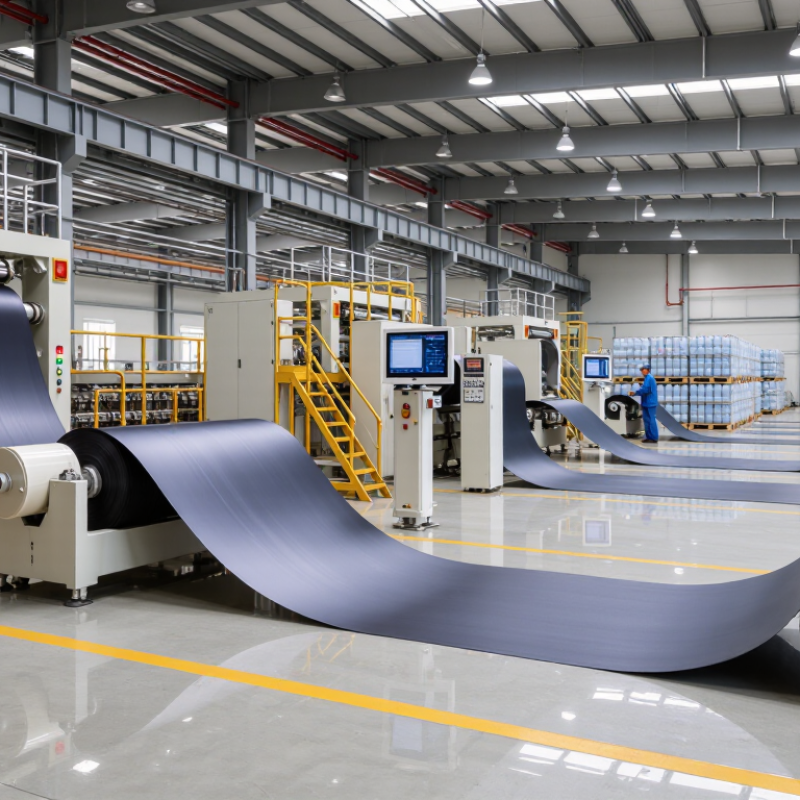
Production begins with resin checks. Technicians verify polymer density and melt flow before extrusion. Heated resin passes through a flat die, then rollers control sheet thickness. Textured liners may receive raised patterns for added friction. Small variations matter. A cool factory floor and calibrated gauges help keep each roll consistent, though process control is never perfect.
Testing checks whether the liner can withstand installation and service stresses. The Geosynthetic Institute’s GRI-GM13 specification sets a minimum density of 0.940 g/cm³ for HDPE geomembranes. For 1.5 mm material, it also specifies minimum tensile strengths of 22 kN/m at yield and 40 kN/m at break. ASTM D6693 covers tensile properties, while ASTM D6392 evaluates field and factory seams. Quality teams also inspect thickness, surface defects, and oxidative resistance, then record results by production lot.
Tips: Ask for lot-specific test reports, not just a general certificate. Check that reported thickness matches the project specification. Request seam-test records too. A strong sheet can still fail at a poorly made seam.
| Production or Quality Dimension | Typical Manufacturing or Inspection Practice | Relevant Data or Test Method | Why It Matters to Buyers |
|---|---|---|---|
| Resin selection | HDPE geomembrane sheet is made from polyethylene resin selected for the required strength, chemical resistance, and service conditions. Resin and additives are controlled through incoming-material checks. | Resin identification and supplier documentation; density can be measured using ASTM D1505 or ASTM D792. | Consistent raw materials help support consistent sheet properties from batch to batch. |
| Sheet forming | Common production methods include flat-die extrusion and blown-film extrusion. Smooth sheet can be textured during manufacture where the project requires increased interface friction. | Production records typically track line settings, roll identification, and product dimensions. | Manufacturing method and surface finish should suit the installation design and contact materials. |
| Nominal thickness | Geomembranes are supplied in a range of nominal thicknesses; 0.75 mm, 1.0 mm, 1.5 mm, and 2.0 mm are common product options, subject to project specifications. | Nominal thickness is measured using ASTM D5199. Acceptance limits depend on the specified product and applicable specification. | Thickness affects design capacity, handling, installation, and the project’s specified minimum requirements. |
| Density | Density is checked on production samples as one indicator of material composition and consistency. | ASTM D1505 or ASTM D792. GRI-GM13 is a commonly referenced specification for HDPE geomembranes; applicable criteria depend on product thickness and specification edition. | Provides a standardized material-property check, but should be considered alongside other test results. |
| Carbon black content and dispersion | Carbon black is commonly incorporated to improve resistance to ultraviolet exposure. Testing checks both its amount and how evenly it is dispersed through the material. | Carbon black content: ASTM D4218. Carbon black dispersion: ASTM D5596. | Appropriate content and dispersion help reduce risks associated with uneven protection and material variability. |
| Tensile properties | Specimens are tested to evaluate tensile behavior, including yield and break properties, where required by the product specification. | ASTM D6693 covers tensile properties of nonreinforced geomembranes. Required values depend on the specified product and thickness. | Supports assessment of material strength and elongation characteristics during handling and service. |
| Tear and puncture resistance | Laboratory samples may be tested for resistance to tear propagation and puncture using standardized procedures. | Tear resistance: ASTM D1004. Index puncture resistance: ASTM D4833. | Relevant to evaluating potential damage during transport, placement, and contact with the prepared subgrade. |
| Oxidative stability | Oxidative-induction testing is used to assess the material’s resistance to oxidation under a defined laboratory procedure. | ASTM D3895 uses differential scanning calorimetry; ASTM D5885 covers high-pressure oxidative-induction time. The selected method and criteria should match the project specification. | Helps compare oxidative stability under controlled test conditions; it does not by itself predict a precise field service life. |
| Roll and surface inspection | Finished rolls are checked for visible surface defects, edge condition, labeling, roll identification, and recorded dimensions. | Inspection records commonly include roll number, width, length, nominal thickness, and observed nonconformities. | Traceable roll records support receiving inspection, installation planning, and resolution of quality issues. |
| Field seam strength | After panels are joined, destructive samples can be taken from trial seams or completed seams to assess peel and shear behavior. | ASTM D6392 covers destructive testing of nonreinforced geomembrane seams. Project-specific requirements determine sampling and acceptance. | Seam performance is an important part of the installed liner system and should be assessed under the project quality plan. |
| Non-destructive seam testing | Depending on the seam type and site procedure, crews may use air-pressure testing of suitable dual-track seams or vacuum-box testing of applicable seams. | Air-pressure testing: ASTM D5820. Vacuum-chamber testing: ASTM D5641. | Allows inspection of completed seams without removing a destructive sample from every tested location. |
| Quality documentation | Buyers can request product data, test reports, roll traceability, and the inspection or testing plan applicable to the order. | Check that reports identify the test method, sample or lot, test date, measured result, and applicable acceptance criteria. | Clear documentation makes it easier to compare products and verify that supplied material matches the project requirements. |
Key Criteria for Evaluating Leading HDPE Liner Manufacturers in China
For global buyers, price per square metre is only a starting point. Grand View Research estimated the global geomembrane market at about US$2.12 billion in 2023. It forecast a 5.6% compound annual growth rate from 2024 to 2030. This signals expanding demand, not factory competence. They are different.
Evaluate material control against recognized benchmarks. The Geosynthetic Institute’s GRI-GM13 specification outlines property and testing requirements for HDPE geomembranes; ASTM D6693 covers tensile testing of nonreinforced geomembranes. Ask whether test results identify the production lot, resin batch, sample location, and test method. Check thickness consistency, tensile properties, carbon-black dispersion, and oxidative-induction results. A polished certificate can still hide weak process control. Numbers can mislead.
Factory evidence matters too. Request recent third-party reports, calibration records, and a clear procedure for handling nonconforming rolls. Ask to inspect roll edges and packaging, then arrange a trial seam using the intended installation conditions. Small details matter. A supplier should explain how it controls temperature, speed, and pressure during welding, even though field crews perform the final installation. Compare lead times, roll dimensions, and replacement procedures in writing. I would not treat a low quote as proof of efficiency; it may simply leave important quality checks undocumented.
Certifications and Quality Standards for Global HDPE Liner Buyers
Global buyers should assess HDPE liner certifications against the project specification, not rely on a certificate alone. An ISO 9001 certificate indicates a quality management system; it does not certify every liner’s performance. Check the certificate’s scope, issuing body, validity dates, and manufacturing site. Request current test reports that identify the tested product and methods. Depending on project requirements, standards such as ASTM or GRI methods may guide testing.
Review measurable properties, including thickness, tensile strength, puncture resistance, and carbon black content. Ask how production lots are identified and whether retained samples can be traced to a shipment. Independent laboratory results add useful evidence, but confirm that the tested sample matches the material being supplied. Paperwork may be neat while traceability remains weak; that gap deserves attention.
Tips: Request a sample roll and compare its label with the test report. Check thickness at several points, not just one edge. Clarify in writing which standards and acceptance limits apply before production begins. A short factory audit can reveal storage or handling issues that certificates cannot show.
Sourcing, Shipping, and After-Sales Support for International Projects
For international projects, choosing an HDPE liner supplier involves more than comparing prices. Share the required thickness, roll width, surface texture, and installation conditions before requesting a quote. Clear specifications help reduce mismatches between the material and site needs. Ask how rolls are labeled and protected for transport. Strong wrapping and clear labels make receiving checks easier, especially after a long sea journey. Confirm production and shipping timelines in writing, and allow extra time for port handling. Delays happen. Even a careful schedule can miss local holidays or weather disruptions.
Tips: Request a sample and review the technical data sheet. Check that the quoted dimensions match your drawings. Keep copies of packing lists and shipping documents.
After delivery, inspect the packaging and record any visible damage before moving rolls to storage. Keep them away from sharp objects and prolonged direct sunlight where practical. If a concern appears, send the supplier clear photos, roll identification, and a brief description promptly. This gives both sides useful details for assessment. Ask in advance how technical questions, replacement discussions, or installation guidance are handled. Support quality can vary, and response expectations are not always obvious. Agree on a contact person and response timeframe before shipment. Good communication will not prevent every problem, but it can make project decisions less uncertain.
China Top HDPE Liner Manufacturers for Global Buyers
Typical HDPE geomembrane thickness options and their estimated material mass per square metre
Estimated mass is calculated from nominal thickness using a reference density of 0.94 g/cm³. Actual roll weight can vary with resin density, surface texture, and manufacturing tolerances. Confirm project specifications, packing, shipping details, and after-sales support with suppliers before ordering.