
2026 Best Motorcycle Ebike for Global Buyers?

Choosing the 2026 Best Motorcycle Ebike for Global Buyers requires more than comparing speed and battery size. A Motorcycle Ebike should feel stable on uneven roads, predictable in traffic, and practical beside a home charging socket. Micah Toll, a respected e-bike journalist and industry analyst, offers a useful principle: “The best e-bike is the one that fits your daily ride.” That idea matters when buyers face different climates, road surfaces, riding habits, and local requirements.

This guide examines motor output, battery capacity, frame strength, braking performance, lighting, suspension, and rider protection. It also considers service networks and replacement-part availability. A powerful motor may climb steep streets easily, but it can increase weight and reduce portability. Large batteries can extend range, yet charging times and shipping restrictions deserve attention. Small details matter. A loose display can ruin a commute.

Real-world testing often differs from showroom claims. Cold weather, headwinds, heavy cargo, and hills can reduce the advertised range. Some models also feel more like compact motorcycles than bicycles, which may affect registration, equipment, and road access in certain regions. Buyers should verify current rules with local authorities before ordering. Standards and classifications can vary widely.

There is no perfect model.

The strongest choice balances performance, reliability, comfort, and responsible ownership. This comparison aims to separate useful engineering from attractive marketing. It may still miss a preference unique to your city or riding style. That is the honest limitation. For global buyers, the best Motorcycle Ebike is not always the fastest option. It is the one that remains dependable after the first exciting ride.
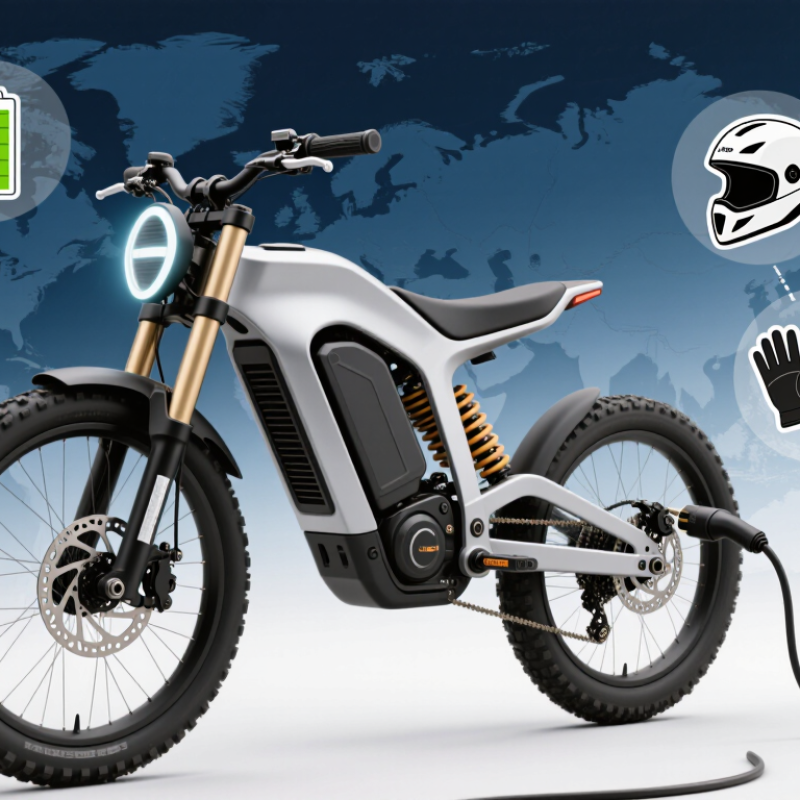
2026 Best Motorcycle Ebike for Global Buyers?

Motorcycle E-Bike Classes: 250 W/25 km/h EU Rules and U.S. Class Standards

Choosing the best motorcycle e-bike for global buyers begins with its legal class, not its motor size. In the European Union, an EPAC generally uses pedal assistance, has a maximum continuous rated power of 250 W, and stops assisting at 25 km/h. The rider must pedal to receive motor support. A thumb throttle, higher assistance speed, or motorcycle-style equipment may place the vehicle outside ordinary bicycle rules. That can affect registration, insurance, helmet duties, and road access.

U.S. class standards use different measurements. Class 1 provides pedal assistance up to 20 mph. Class 2 adds a throttle, usually limited to 20 mph. Class 3 provides pedal assistance up to 28 mph, although local rules can differ. Some states restrict Class 3 bikes from paths, while others apply separate requirements to heavier or faster models. The same vehicle may be treated as a bicycle in one area and a motor vehicle elsewhere.

Check the frame label, continuous motor rating, assistance cutoff, throttle function, and vehicle weight before buying. A short test ride can reveal delayed engagement, weak braking, or uncomfortable handling. I once thought speed was the clearest comparison. It was not. Tire width, lighting, mirrors, and stopping distance may matter more in daily traffic. Always confirm current rules with the relevant transport authority, because product listings often simplify legal categories.

2026 Best Motorcycle E-Bike for Global Buyers? E-Bike Class Speed Comparison

Maximum assisted-speed limits differ by market. EU-compliant pedelecs are generally limited to 25 km/h with a 250 W continuous rated motor, while the commonly used U.S. class framework defines Class 1 and Class 2 bicycles up to 20 mph and Class 3 bicycles up to 28 mph. U.S. rules and access requirements can vary by state and local jurisdiction.

Battery and Motor Benchmarks: Comparing 2–10 kWh Packs and 3–15 kW Outputs

2026 Best Motorcycle Ebike for Global Buyers?

Battery size changes the riding experience more than peak power figures. A 2 kWh pack suits short urban trips, but hills, cold weather, and heavy loads reduce usable range. Packs from 5–10 kWh offer greater flexibility for touring, although they add weight and charging time. The IEA Global EV Outlook 2024 reported a sharp decline in lithium battery costs, while BloombergNEF recorded an average pack price of 115 dollars per kWh in 2024. Prices may fall further, but retail systems remain more expensive.

Motor output needs careful reading. A 3 kW continuous motor can handle city traffic efficiently. A 15 kW system delivers stronger acceleration, yet it demands better cooling, brakes, tires, and chassis design. Peak output alone can mislead buyers. Ask for continuous power, battery voltage, controller limits, and thermal test conditions. Independent testing matters. The UNECE Global Technical Regulations provide useful safety references for electric powertrains, but national requirements still differ. A promising specification sheet is not proof of reliability.

Tips: Match battery size to daily distance, not advertising range. Check charger compatibility before importing. Confirm replacement-cell availability locally. Leave 10–15% battery capacity unused during regular trips. That small reserve can protect long-term performance. Also inspect water resistance, service access, and certified braking equipment. I would not choose a 15 kW model without reviewing its heat management data. Numbers look precise. Real roads are not.

Range, Charging, and Efficiency: Evaluating Wh/km, Fast Charging, and Cycle Life

For global buyers, the best motorcycle ebike depends on usable energy, not headline range. Measure efficiency in Wh/km under repeatable conditions. A 3 kWh battery may deliver about 50 kilometers at 60 Wh/km. Wind, steep roads, cold weather, luggage, and rider weight can raise consumption sharply. A practical test should record speed, temperature, payload, tire pressure, and elevation. One ride is not enough.

Charging speed matters during daily work. A 6 kW charger could refill a 3 kWh battery in roughly 30 minutes under ideal conditions. Real charging takes longer because power usually tapers near full capacity. Check the charger output, connector standard, local voltage, and available electrical supply. A smaller charger may be slower, but it can reduce heat and simplify home installation.

Cycle life should be judged by usable capacity after repeated charging, not by a vague battery warranty. Frequent high-current charging may increase thermal stress, especially in hot climates. Look for temperature monitoring, balanced cells, and clear test conditions. Ask whether the cycle rating reaches 80 percent capacity. That detail changes the comparison. My own range estimates are never perfectly clean; traffic and wind create annoying variation. A route tested at 22°C may perform very differently at 5°C. Also, advertised Wh/km figures often seem optimistic. Record several rides, compare energy from the wall, and leave a reserve for unexpected detours.

Safety and Certification: UL 2849, EN 15194, UN 38.3, and IP Ratings

For global buyers choosing the best motorcycle ebike in 2026, certification matters more than a large battery display. The IEA’s Global EV Outlook 2024 reports that electric two- and three-wheelers remain the world’s largest electric road-vehicle segment by volume. That scale increases the need for traceable testing, not just attractive specifications.

UL 2849 evaluates the electrical system, including the battery, charger, wiring, and controls. It can reduce fire risks caused by poor integration. EN 15194 covers electrically assisted cycles in Europe, typically limited to 250 watts and 25 km/h. A powerful motorcycle-style ebike may exceed these limits. Then, EN 15194 may not be the correct classification. UN 38.3 concerns lithium-battery transport testing, including vibration, shock, and altitude simulation. It supports safer shipping, but it does not certify the complete vehicle.

Check the actual certificate number and testing scope. A printed logo is weak evidence. IEC 60529 IP ratings describe resistance to dust and water, such as IP65 or IP67. They do not promise safety after pressure washing, crashes, or salt exposure. The U.S. Consumer Product Safety Commission recorded hundreds of micromobility fire and overheating incidents from 2017 through 2023, showing why battery quality deserves careful inspection. I would also examine connectors, charging temperature, brake performance, and replacement-cell control. Certification is valuable. It is not a lifetime promise.

2026 Best Motorcycle Ebike for Global Buyers? - Safety and Certification: UL 2849, EN 15194, UN 38.3, and IP Ratings

A practical comparison of the main safety standards, transport tests, and ingress-protection ratings relevant to electric bicycles and motorcycle-style ebikes sold internationally.

Standard or Rating Primary Purpose What It Covers Key Technical Scope Typical Buyer Evidence What It Does Not Prove Global Relevance
UL 2849 Electrical-system safety evaluation for e-bikes Rechargeable battery systems, chargers, power supplies, wiring, controls, motors, and protection against electrical, fire, and shock hazards Evaluates the integrated electrical drive system under defined test conditions. The exact certification scope depends on the certified configuration. Certificate or certification record identifying the tested model, battery, charger, and electrical-system configuration It does not automatically confirm road legality, crash protection, riding quality, or compliance with every country’s vehicle rules. Market-dependent
Especially useful in North American procurement and retail channels; local requirements may differ.
EN 15194 Safety requirements for electrically powered assisted cycles, commonly called EPACs Mechanical strength, braking, steering, pedals, lighting-related provisions, electrical safety, electromagnetic compatibility, battery and charger requirements For the commonly recognized EU EPAC category: motor assistance up to 25 km/h and a maximum continuous rated motor power of 250 W. National implementation and vehicle classification must still be checked. Declaration of Conformity, technical file reference, test reports, product marking, and operating specifications matching the supplied configuration It does not cover every high-power or high-speed electric motorcycle. A model exceeding EPAC limits may fall under a different vehicle category. Important in Europe
Useful for determining whether a model fits the EU EPAC framework, subject to local law.
UN 38.3 Safety testing for transporting lithium batteries and cells Altitude simulation, thermal test, vibration, shock, external short circuit, impact or crush where applicable, overcharge for rechargeable batteries, and forced discharge for certain cells Applies to the battery or cell type before transport by air, sea, road, or rail. Test requirements and documentation depend on the battery design and shipping configuration. UN 38.3 test summary identifying the battery or cell type, manufacturer or responsible entity, test report reference, and revision information It is not a complete ebike product-safety certification and does not prove that the bicycle, charger, or battery-management system is safe in every riding condition. Transport-related
Essential for international logistics, but shipping carriers and jurisdictions may impose additional requirements.
IP54 Basic protection against dust ingress and water splashes First digit 5: limited dust ingress protection. Second digit 4: protection against water splashing from all directions Suitable for ordinary light rain and splash exposure when the product is used as specified. It is not a waterproof rating. IP test report or certificate referring to the complete enclosure and the tested product configuration It does not guarantee safe immersion, pressure washing, corrosion resistance, or protection if covers and seals are damaged. Product-dependent
A practical minimum target for normal commuting, provided the manufacturer gives clear operating limits.
IP55 Improved protection against dust and low-pressure water jets First digit 5: limited dust ingress protection. Second digit 5: protection against low-pressure water jets from any direction Offers more water-jet resistance than IP54, but it is still not designed for immersion or high-pressure cleaning. Independent IP test report for the assembled electrical enclosure, battery housing, display, controller, or other specified component It does not prove that every electrical component on the ebike has the same rating. Product-dependent
Useful for riders who regularly encounter heavy rain, wet roads, or road spray.
IP65 High protection against dust and low-pressure water jets First digit 6: dust-tight. Second digit 5: protection against low-pressure water jets Provides stronger dust protection than IP54 or IP55. It still does not authorize immersion or pressure-washer use. Test documentation that states the exact enclosure, test method, product model, and rating achieved It does not eliminate the need for correct charging, storage, sealing maintenance, or battery safety procedures. Product-dependent
A strong target for wet or dusty environments when verified for the complete relevant assembly.
Battery-management system Control battery charging, discharging, temperature, and fault conditions Overcharge protection, over-discharge protection, over-current protection, short-circuit protection, temperature monitoring, and cell balancing where designed into the system Performance depends on the cells, wiring, firmware, sensors, charger compatibility, and protection thresholds. Battery specification sheet, charger compatibility statement, protection-function description, and service or replacement procedure A BMS alone is not a substitute for recognized product certification, transport testing, quality manufacturing, or safe user practices. Essential design feature
Buyers should verify that the battery, charger, and BMS are supplied as one tested system.
Charger compatibility Prevent unsafe charging caused by mismatched voltage, current, or connector systems Output voltage, current rating, connector polarity, charging protocol, thermal behavior, and protection against abnormal charging conditions The charger must be specified for the exact battery voltage and battery-management system. A physically compatible plug may still be electrically unsafe. Charger label, input and output ratings, conformity documentation, model compatibility list, and replacement-charger instructions Universal or third-party chargers should not be assumed safe solely because the connector fits. Essential operating requirement
Voltage, plug type, and electrical approvals must match the destination market.
Certification scope Confirm that the documentation covers the exact frame, motor, battery, charger, controller, and display configuration being purchased.
Power and speed category Check continuous rated motor power, maximum assisted speed, throttle operation, and local classification before importing or registering the vehicle.
Battery transport documents Request a current UN 38.3 test summary and confirm that the shipping battery model matches the document.
Ingress protection Prefer a documented rating such as IP54, IP55, or IP65 for the relevant enclosure. Do not treat an unverified marketing claim as certification.
Charging system Verify destination-country input voltage, plug type, charger approval, battery voltage, charging current, and approved replacement procedure.
Mechanical safety Check braking performance, tire load rating, wheel and frame load limits, lighting, reflectors, steering components, fasteners, and suspension requirements.
Weather limitations Follow the manufacturer’s instructions for rain, storage, cleaning, charging, and immersion. Never charge a wet, damaged, swollen, or unusually hot battery.
After-sales support Confirm availability of approved batteries, chargers, brake parts, tires, firmware support, service instructions, and safe battery-disposal channels.
Important: UL 2849, EN 15194, UN 38.3, and IP ratings address different risks and are not interchangeable. A model can satisfy one requirement without satisfying the others. Always verify the destination country’s road-use, electrical, radio-equipment, transport, recycling, and registration rules before purchase.

Global Buying Guide: Comparing Cost, Warranty, Import Duties, and Local Compliance

2026 Best Motorcycle Ebike for Global Buyers?

The best motorcycle ebike is not always the cheapest online listing. The International Energy Agency reported over 25 million electric two- and three-wheelers sold globally in 2023. That scale improves component availability, but local prices still vary sharply. Compare the complete landed cost: vehicle, battery, freight, insurance, customs duty, VAT, assembly, and registration. A low factory price can become expensive after arrival.

Warranty deserves a closer inspection. Ask who pays return freight, battery testing, labor, and diagnostic charges. Confirm whether coverage starts at purchase or delivery. A 24-month vehicle warranty may exclude the battery, charger, water damage, and commercial use. That wording matters. I have seen buyers focus on duration and miss service access.

Compliance is less visible, but more important. Local rules may classify an ebike by motor output, assisted speed, weight, or required equipment. Check approved lighting, brakes, mirrors, reflectors, noise limits, and battery certification before paying. The United Nations Economic Commission for Europe publishes vehicle regulations that influence many national approval systems, while the EU Battery Regulation adds requirements for battery information and sustainability. Import procedures also differ by destination; the World Bank’s 2023 Logistics Performance Index shows wide gaps in customs efficiency between countries. Treat online specifications as incomplete. Ask for conformity documents, serial-number records, charging compatibility, and a written duty estimate. Mistakes happen.

Go to Top